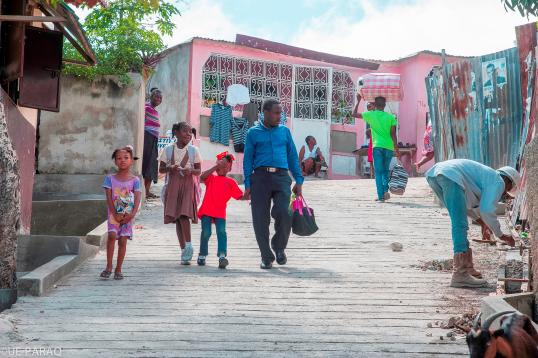
Haiti is a fragile Caribbean country facing multiple structural development challenges: a high dependence on fossil fuel, a vulnerability to natural disasters, political instability, economic fragility, a food and nutrition crisis, and a persistent cholera epidemic.
As a result, Haiti is the poorest and most inequitable country in the region. Poverty, insecurity, and corruption have become structural and public distrust in government is widespread.
Haiti is still recovering from the devastation caused by the 7.0 magnitude earthquake that shook the country in 2010, compounded by the effects of hurricane Matthew in 2016, which led to a loss of 32% of the national added value.
Our priorities
Haiti, the poorest country in the Latin America and Caribbean region and the least developed country in the Western Hemisphere, faces important challenges, namely weak state capacity, social inequality, insecurity, a weak civil society, and high vulnerability to natural disasters.
In this context, the EU's strategic interest is to promote sustainable development and poverty reduction, promoting a stable and democratic country, better integrated into the Caribbean region, where the EU is present through its overseas territories, and in the international community.
Three priority areas are proposed in the MIP:
Democratic, economic, and financial governance
The scope and severity of governance problems in Haiti require focusing on specific objectives. The following axes have been selected:
- Strengthening the accountability of public authorities and the participation and control of civil society.
- Improving the efficiency of public finance management.
- Promoting the business climate and sustainable investments.
Human resources development
While Haitian families strongly value education and devote a significant portion of their resources to it, the education sector is suffering from a serious deterioration in quality. With half of the population under 25 years of age, who will soon become the agents of change, special attention must be paid to the youth. Considering this context, we have planned the following actions:
- Consolidation of the governance of education at all levels, including vocational training.
- Development of human capital through non-formal learning and continuing education for all.
- Advancement of the social protection system.
Productive and resilient territories
Unlike the two previous priority areas, which have a national dimension, the aim here is to combine an integrated approach with a territorial approach focusing on one or more geographical areas that remain to be defined. Within these territories, the following priorities will be taken into account in their level of devolution and decentralization:
- Promotion and enhancement of equitable, climate-resilient, biodiversity regenerating, and sustainable agri-food systems.
- Improvement of urban resilience to physical, climatic, ecological, and economic risks.
The logic of the European Green Deal is particularly well suited to this priority area as a growth strategy based on environmental sustainability and the consideration of climate change.
Our programmes
The Multiannual Indicative Programme (MIP) for Haiti for 2021-2024 amounts to €120 million.
Priority area 1: ‘Democratic, economic and financial governance’ strengthens the accountability of public authorities and the participation and control of civil society while ensuring the efficiency of public financial management and improving the business climate and sustainable investments.
Priority area 2: ‘Human resources development’ encourages the development of governance and education at all levels, including vocational training while reinforcing the social protection system.
Priority area 3: ‘Productive and resilient territories’ promotes and enhances sustainable equitable climate-resilient agri-food systems and improves urban resilience to physical, climatic, ecological, and economic risks.
Support measures
Civil society has a central role in this MIP, as a direct target of interventions, due to the central role it is given in all three priority areas. In addition, civil society organizations together with state institutions, receive direct support within the framework of the development priority area.
It should also be mentioned that this is in line with the programs and initiatives undertaken in the framework of the MIP 2014-2020 and will allow for the implementation of the activities financed by the thematic programs that will mainly complement and reinforce the support through a more focused intervention in the areas of human rights, citizen participation, women’s empowerment, and media.