
What is development effectiveness?
Development effectiveness is about increasing the impact of our development cooperation. Aid is a limited resource, which needs to be spent as effectively as possible in order to achieve the best, fastest and most sustainable impact for those most in need. Better policies in developing countries, coupled with effective development cooperation, ensure that aid will be more effective in reducing poverty and achieving sustainable development.
Our approach
We strive to strengthen the effectiveness of our development cooperation by:
- defining our objectives based on our partner countries’ own development priorities to;
- supporting the policy processes through which these priorities are formulated, as well as the results frameworks established to manage and report on them;
- strengthening and building on partner countries’ own systems deliver on policy objectives and implement development programmes; and
- providing more of our support through coordinated aid modalities, such as budget support.
Global partnership for effective development cooperation
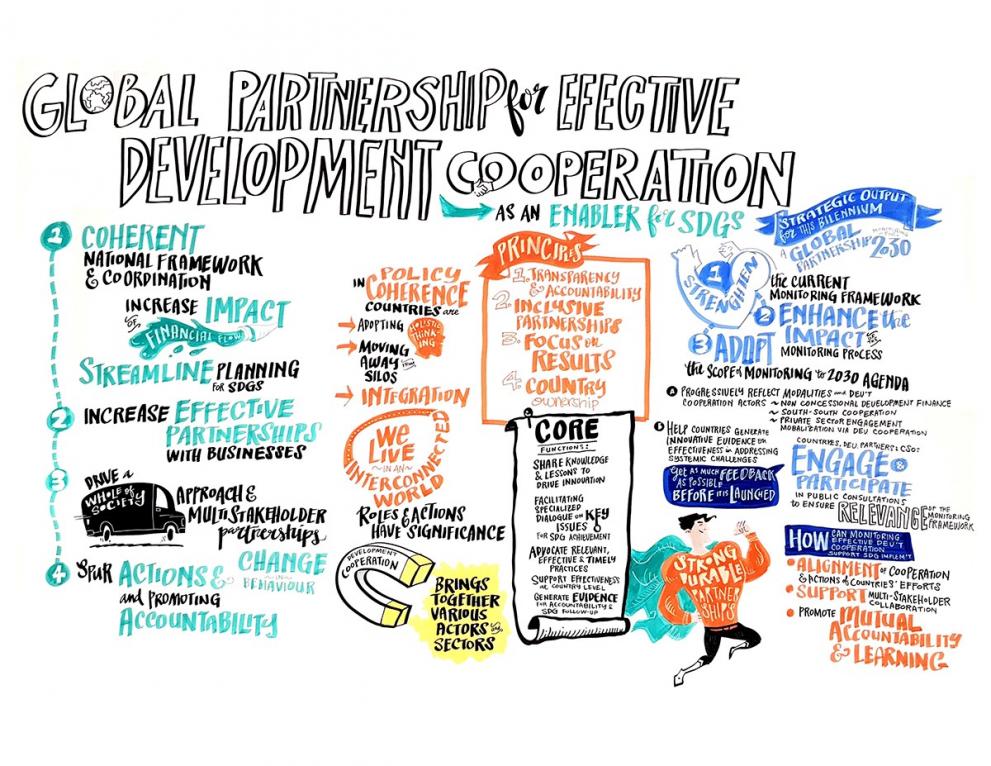
We recognise that we are one player among many, and that the benefits that accrue in terms of the impact of our aid and the success of the development process in our partner countries also depend on how others act. Inappropriate policies by our partner countries and poor practice by other development cooperation providers can to negatively affect our aid and the environment in which it is delivered. We therefore strive to ensure that the approaches used by governments, donors and other partners at country-level are consistent with the principles and practices of development effectiveness.
For this reason, the EU is a member and active supporter of the Global Partnership for Effective Development Cooperation (GPEDC). This multi-stakeholder platform brings together governments, bilateral and multilateral organisations, and representatives from civil society, the private sector, parliaments, local governments and trade unions, to advance the effectiveness of all development actors’ efforts.
Development effectiveness principles
The GPEDC was established in 2011 at the Busan High-Level Forum on Aid Effectiveness, which defined the four development effectiveness principles that form the basis of the partnership’s work:
- ownership of development priorities by developing countries
- focus on results
- inclusive partnerships
- transparency and mutual accountability
All forms of development cooperation should be founded on these four principles. Development cooperation includes all international public and private finance targeted at development outcomes, as well as domestic finance and policy. This includes not only official development assistance (ODA), but non-ODA climate finance, other official flows, South-South and triangular cooperation, funds and blended public/private finance, civil society actions and some non-financial co-operation including policy measures and private sector engagement. All of these resources should complement each other and work together as effectively as possible.
The development effectiveness principles defined at the Busan high-level forum build on the aid effectiveness principles in the Paris Declaration on aid effectiveness (2005) and the Accra Agenda for action (2008). These principles were further reinforced in the Mexico communiqué (2014) adopted during the first high-level GPEDC meeting and the Nairobi outcome document agreed at the second high-level meeting in 2016.
Our role
The EU plays an active role in the GPEDC:
- We have been a member of its steering committee since its foundation - representing European development aid providers.
- We contribute to key areas of its work programme.
- We support the update of the effectiveness monitoring indicators, to better align them with the Sustainable Development Goals.
- We support the implementation of the 2018 Global Monitoring Round, which assesses countries adherence to the effectiveness principles.
- We lead, together with Germany and Bangladesh, the roll-out of pilot projects aimed at building good practices at country-level.
- We support the formulation of principles and guidelines to ensure private sector engagement is effective in delivering on development outcomes, the Sustainable Development Goals and the commitment to leave no-one behind.
In addition to our work to build global consensus on development effectiveness, we also pursue greater effectiveness in our own development cooperation and that of EU Member States, through our Joint Programming and ‘Working Better Together’ initiatives.
Joint programming
Joint programming is a practical, country-level approach to improve the EU’s and EU countries’ development cooperation and that of their partners. Through Joint Programming, we coordinate with EU countries to reduce donor fragmentation and transaction costs and optimise European development aid. We decide collectively on common development and external action objectives and agree on the strategic, financial and technical assistance approaches we want to implement in partner countries. This process started in 2012 and several joint strategies are currently in place in different partner countries (see the Joint Programming tracker).
Joint programming improves overall aid coordination, coherence, and transparency. It reinforces mutual trust and knowledge between the EU, its member countries and other like-minded partners.
Results
In order to keep track of the results of joint strategies, we launched the EU international development and cooperation results framework in 2015. It was revised in 2018 to align with the new European development objectives, as set in the European Consensus on Development.
The results framework defines a set of indicators to use for the collection, aggregation, and presentation of data, and which serve as standards for our yearly activity reports in partner countries. It helps us identify clear and measurable results and makes us more accountable.
Detailed Analysis of EU Performance

In June 2020, the European Commission published a new study that provides a snapshot of how well the EU and its Member States are implementing the aid and development effectiveness principles in their ODA to developing countries. The study is based on data collected for the 2019 Global Progress Report published by the Global Partnership for Effective Development Cooperation (GPEDC).
Despite a continued commitment in EU and Member State policies to the effectiveness principles, the study finds deteriorating performance against most effectiveness targets, explores the reasons behind this and identifies the key issues that need to be addressed to reinvigorate development effectiveness and achieve more rapid progress on the SDGs.
Related links
Global Partnership for Effective Development Cooperation (GPEDC)
UN 2030 Agenda for Sustainable Development
OECD – High level forums on aid effectiveness
International Aid Transparency Initiative (IATI)
New Deal for Engagement in Fragile States
European Consensus on Development
The Paris Declaration on aid effectiveness and the Accra Agenda for action
The Paris Declaration on aid effectiveness – OECD summary factsheet
The Accra Agenda for Action - OECD summary factsheet
Busan high-level forum on aid effectiveness – outcome document
Global Partnership for Effective Development Cooperation (GPEDC) – Mexico communiqué